
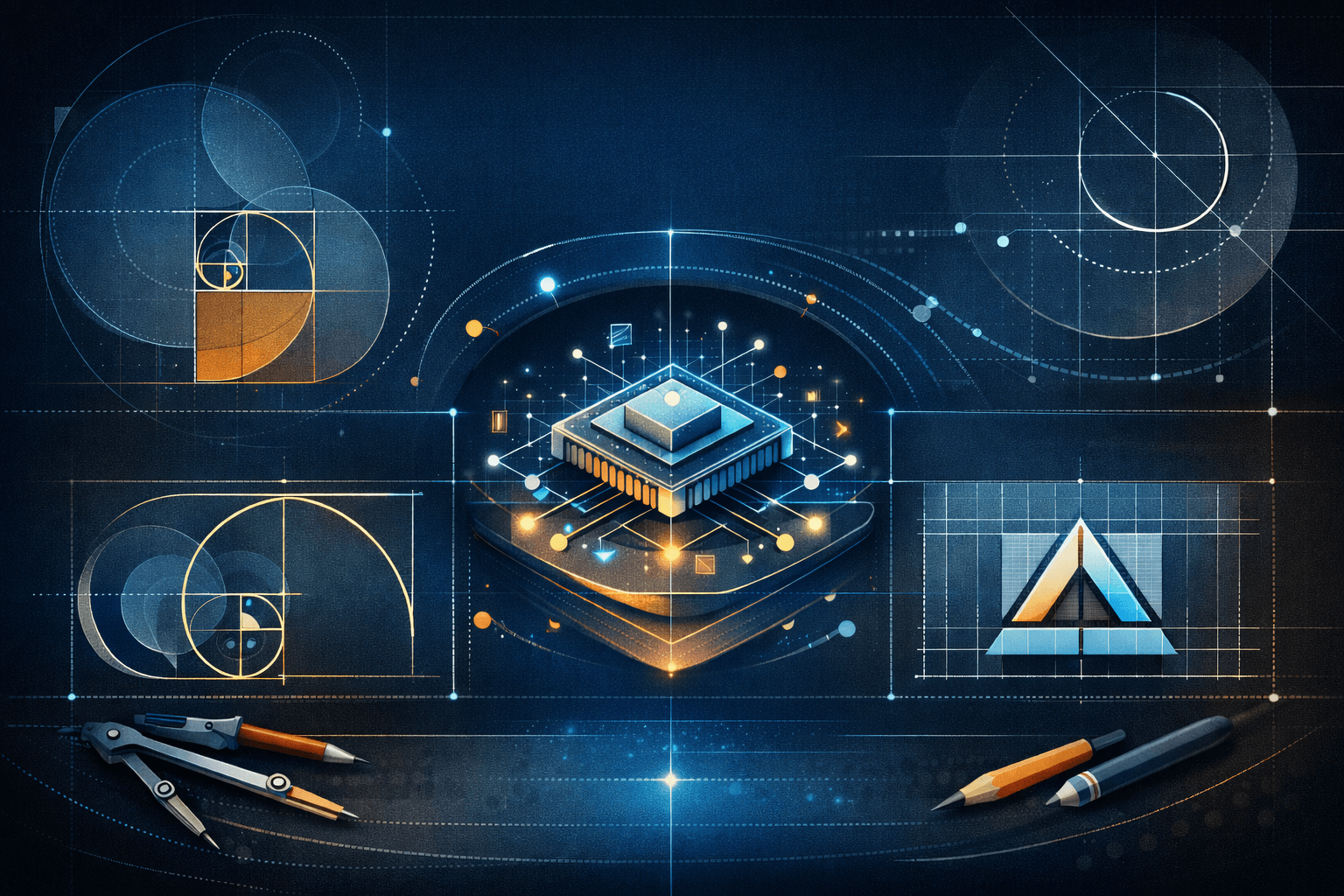
Logos look simple. A circle. A line. A mark you remember. But behind many modern symbols sits a quiet structure made of numbers, ratios, and rules. Today, mathematical patterns in design play a major role in how brands look and feel. When algorithms enter the process, these patterns become even more important. In the world of ai-generated logos, math is not decoration. It is the foundation.
Designers once sketched for weeks. Now systems calculate in seconds. Still, the goal stays the same: clarity, balance, and meaning.
The Hidden Logic of Visual Symbols
Every shape has a relationship with another shape. Every curve reacts to space.
When designers analyze shape relationships, they are already thinking mathematically, even if they do not use formulas. AI systems make this thinking explicit. They measure distance, angle, scale, and repetition.
Studies in visual perception show that people process symmetrical images up to 20 percent faster than irregular ones. That speed matters. A logo often has less than two seconds to make an impression.
Mathematical patterns in design help remove noise. They guide the eye. They create calm.
Geometry in Logo Creation
Geometry in logo creation is not new. Ancient symbols used circles to suggest unity and squares to suggest stability. What is new is precision at scale.
AI tools apply geometric principles consistently. They calculate grids, anchor points, and ratios without fatigue. A human might adjust a curve by feel. An algorithm adjusts it by exact proportion.
Common geometric elements include:
- Circles for continuity and trust
- Triangles for movement and direction
- Rectangles for order and reliability
When these forms follow shared rules, the result is cleaner. More readable. Easier to remember.
Symmetry, Proportions, and Balance
To use symmetry and proportions is to speak a visual language people already understand. Nature uses it. Faces use it. Architecture depends on it.
AI systems generate visual balance by testing thousands of variations. Some are mirrored. Others use near-symmetry, where balance exists without perfect reflection. This creates energy without chaos.
The golden ratio often appears in logo systems. Roughly 1:1.618. Designers have used it for centuries. But while previously everything had to be calculated manually, now there's a math solver for Chrome. All you need to do is add to browser a math solver for Chrome and set the initial inputs. This is applicable to everything from graphics to rocket science calculations.
According to a 2023 branding survey, logos rated as “balanced” were 33 percent more likely to be described as trustworthy. Numbers influence feelings.
Combining Math and Creativity
There is a myth that math kills creativity. Reality shows the opposite.
When designers combine math and creativity, they reduce random choice and focus on intent. AI does this by removing weak options early. It tests, scores, and refines.
Creativity shifts from guessing to guiding. Humans choose direction. Machines explore variation.
This partnership allows designers to focus on story, emotion, and brand voice, while AI handles structure, spacing, and proportion.
Automate Logo Design Without Losing Meaning
To automate logo design does not mean removing humans. It means removing repetition.
AI tools generate hundreds of logo concepts in minutes. They adjust color, form, and layout automatically. This speed matters for startups and small businesses. Research shows that early brand consistency can increase customer recognition by over 25 percent in the first year.
Automation also supports experimentation. Designers can test bold shapes without risk. If one fails, another appears instantly.
Math makes this automation stable. Rules prevent visual collapse.
Shape Relationships and Scalable Design
A logo must work everywhere. On a phone. On a billboard. On fabric.
To create scalable designs, AI models analyze shape relationships at multiple sizes. They remove details that disappear when scaled down. They reinforce outlines that stay strong.
Mathematics allows this adaptation. Ratios stay constant. Spacing adjusts proportionally. The logo remains recognizable.
This is why many ai-generated logos feel clean. They are built for flexibility from the start.
Improving Aesthetic Consistency Across Brands
Brands rarely use one logo alone. They use systems.
AI helps improve aesthetic consistency by applying shared mathematical rules across all assets. Icons, sub-logos, and layouts follow the same grid. The same proportions. The same logic.
A study of global brands found that consistent visual systems increased brand recall by nearly 40 percent compared to fragmented ones.
Math creates order. Order builds trust.
Optimizing Visual Harmony Through Algorithms
To optimize visual harmony, AI compares contrast, alignment, and rhythm. It measures white space. It balances weight.
Humans feel harmony. Machines calculate it.
When systems test combinations, they often remove extremes. What remains feels natural. Calm. Intentional.
This does not mean all logos look the same. It means they avoid visual conflict.
Harmony is not boring. It is stable.
Enhancing Brand Identity with Precision
A strong logo does more than look good. It signals values.
AI systems enhance brand identity by matching shapes to traits. Sharp angles for innovation. Soft curves for care. Wide spacing for openness.
These choices are supported by data. Eye-tracking studies show that rounded shapes are associated with friendliness in over 70 percent of participants.
Math turns emotion into repeatable structure.
Structure Creates Freedom
AI-generated logos are not cold or mechanical. They are structured.
Mathematical patterns in design allow logos to be clear, scalable, and consistent. Geometry in logo creation provides order. Algorithms generate visual balance. Designers guide meaning.
When numbers and imagination work together, results improve. Math does not replace creativity. It supports it.